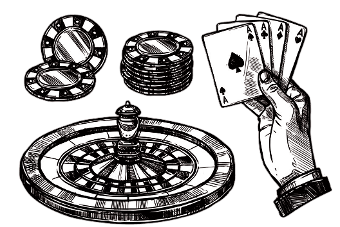
Martingale Roulette Strategy
When you see that guy at the roulette table skillfully scatter chips, he most likely uses the Martingale strategy. This method depends on doubling your bets after losing to recover all previous losses and make a small profit. In other words, if you place bets on only one color and continue to double them until you win, you will reimburse your losses. This is provided that you continue to double your losing bets.
Reverse Martingale Roulette Strategy
As you would expect, given the name, this roulette game is the opposite of Martingale strategy. Instead of raising bets when you lose, the point is to increase them when you win, and lower them after losing. The idea is that you will benefit from the hot streaks and minimize your losses during gross corrections.
D'Alembert Roulette Strategy
For those looking for something more secure than Martingale or Reverse Martingale roulette strategies, D’Alembert is the perfect alternative. This simple gaming method is achieved by increasing and decreasing bets on the basis of one, which is much safer than doubling.
Fibonacci Roulette Strategy
Fibonacci Roulette Strategy Leonardo of Pisa, also known as Fibonacci, was a famous Italian mathematician who wrote about a specific series of numbers in the early 1200s. In fact, the sequence is characterized in that each number after the first two is the sum of the previous two. So, Fibonacci go like this: 1, 1, 2, 3, 5, 8, 13, 21, 34, 55, 89, 144, etc.
When it comes to roulette strategies, the Fibonacci strategy includes bets, adding the last two bets together. With this method, you can leave profitably even if you lost more games than you won.
James Bond Roulette Strategy
Discover the roulette game strategy that Jan Fleming came up with and his famous character used at the table. Fleming told people that his “reliable” method could bring you the “price of a good meal” if you use it every night. For this roulette win strategy, players need at least $ 200.